


“Procario is taking wood to its apparent limit and just one step beyond.”
— Glenn Adamson
Todd Merrill Studio has represented artist John Procario since 2016. Procario is an artist whose practice draws on both his BFA in Sculpture and growing up watching his father, a carpenter, in his woodshop. He makes everything by hand through an intuitive process of experimentation and discovery. Procario entered the world of art and design with a well-founded love of woodworking and a distinct vision inspired by his deference for the material’s possibilities and limitations. Working intuitively, each of Procario’s works begin as a vague idea. Subsequently, Procario develops the work tactilely, first via a model and only later through drawing. His training as a sculptor remains abundantly evident in his expressive shapes, produced by cutting, gluing, and bending micro-thin veneers together by hand and finally carving the resulting structure. Unlike steam bending, each form is built gradually through layers. Procario has pioneered techniques of seamlessly weaving LED into his cold-pressed sculptures that has become one of the defining innovations in collectible design during the first quarter of the twenty-first century.
Starting with his Freeform Series, and later translating this series to develop new works, Procario continues to create elegant, minimalist contemporary designs that engage viewers through both sensation and observation.
While studying sculpture in graduate school, Procario developed a singular design language that began with the notion of wood as metaphor for the human body. “I would describe my work as having a heartbeat,” says Procario. “Each one has so much personality. As you move around them, the forms appear to shift and change. Just as we push the limits of our bones and muscles, I enjoy pushing the limits of wood to create a sense of strain in the material’s gesture,” Procario further elaborates. By pushing the limit of breakage, Procario creates a sense of strain in the otherwise fluid gestures of his works. As the curator Glenn Adamson writes, “The energy contained in his bentwood shapes, the force and skill that it took to create them, is palpable.” Conceptually, this reveals beauty to be the product of stress.
This evocation of the human form found throughout his Freeform Series can also be found in his recent furniture pieces, where he continues to transcend the material’s inherent confines. Procario tends to do work instinctively, beginning with a first sprouting vector and allowing the rest to flow naturally from there, he bends the wood into one of his signature undulating shapes. This reactive process is made materially explicit in a recent collaboration entitled Anthropose, in which sculptor Alex Roskin created bases in bronze, which Procario then completed with an illuminated bentwood superstructure; the series title reflects the figural nature of the compositions.
While developing his technique, Procario spent months intentionally “breaking” wood to gain a deep understanding of its structure, learning where to draw the line before hitting that breaking point. The process is a delicate one. “Wood doesn’t always want to work with you when you are freeform bending so you have to work with it,” he says. “But I really enjoy that. Sometimes it takes you in new directions that would never have happened if everything was planned out.” In this way, the artistic process becomes a collaboration between the artist and the material’s respective personalities. The outcome is an organic, fluid design balanced with a sense of motion.
Procario has further explored these curvilinear forms in his other pieces such as his Crevasse and Basin Series, where he has found inspiration in topography and its twisting forms. Across his lighting work, stretched cotton or linen diffusers serve to soften the built-in LED light sources—an effect further amplified in his Crevasse and Basin series, in which timber curvatures are positioned to catch the light. The outcome is an organic, fluid design highlighting the natural elegance of his materials.
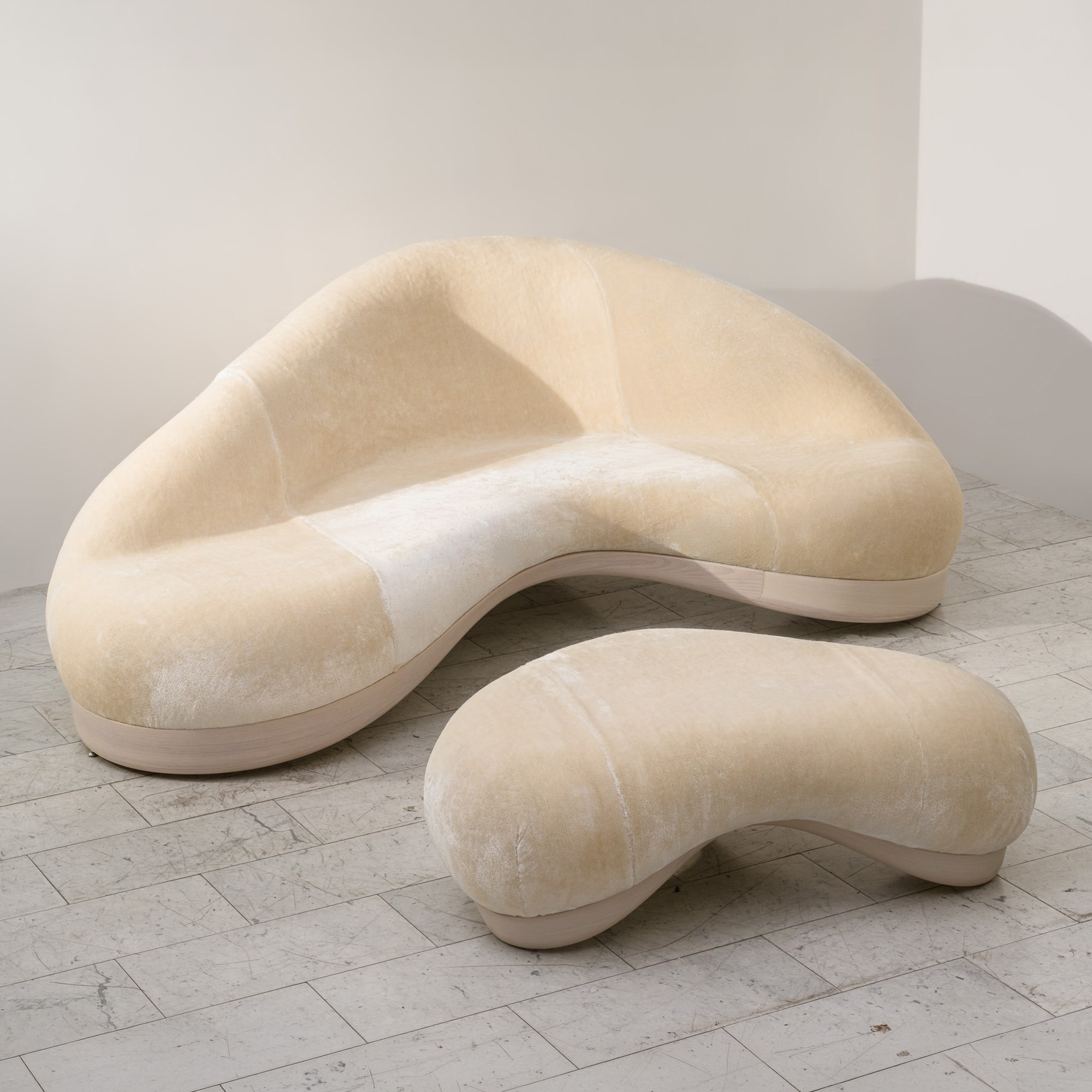
Procario’s Sculpted Seating series expands upon his early exploration of furniture design first developed in 2019 inspired by his minimalistic light sculptures in the Freeform Series. Maintaining his signature visual language, the Sculpted Seating series is a culmination of all of his bodies of work, the lyrical line of the Freeform lighting series, the play of mass and scale seen in the Basin and Crevasse lighting series, and the relationship to the human form in the Posterior lounge chair and benches. Conceived as sculptural objects in their own right, each Seating piece begins with Procario’s signature approach to line and form, built from the ground up as a three-dimensional wood sculpture before being transformed into seating. The organic, undulating structure is meticulously built and refined by hand, creating a sense of movement and visual lightness even within a compact form. Upholstery follows the contours of the sculpted base, softening the linear construction while allowing the underlying gesture of the sculpture to remain legible. With each new series and work produced, Procario’s sense of line and form is further honed.
“It is certainly possible to name precedents and peers for Procario: early American inventor Samuel Gragg and the nineteenth-century Austrian industrial innovator Michael Thonet, who first proved that bentwood furniture could be realized; modernists like Alvar Aalto and Isamu Noguchi who created abstract, biomorphic designs; and other contemporary maestros of lamination, like Wendell Castle, Marc Fish, and Joseph Walsh. These names do provide useful context for what Procario is doing, but his works float free of them nonetheless; each is a pure boundary, establishing its own framework of reference,” Adamson writes.
A growing list of high-end designers have begun including Procario’s large-scale commissions in both commercial and residential projects such as a monumental work installed in the lobby of the Kaufman Organization’s Nelson Tower at 450 7th Avenue, in New York City. “These pieces use the same language,” says Procario. “But more space gives me more opportunity to play with the shapes.”
Procario’s works have been featured in the New York Times, Architectural Digest, Design Milk, Interior Design Magazine, and Luxe Magazine. In the summer of 2018, Procario was invited to produce a unique work for a multi-artist installation at Philip Johnson’s Glass House.
As Procario works on a commission basis, custom designs may be requested.